 Reason wrote about HLLI’s free speech victory in Accountability in State Government and Dan Bartel v. Austin Knudsen.
This week, Watters found that Bartel and his group are likely to succeed on their First Amendment challenge. Montana’s statute covers synthetic media created “with the intent to injure the reputation” of a candidate or political party, meaning that, as Watters put it, the law “treats identically deceptive media differently based solely on whether its message is weaponized to damage or deployed to elevate a candidate.”
Adam Schulman—an attorney at the Hamilton Lincoln Law Institute, which is representing Bartel in the case—says that this was the statute’s fundamental flaw. “You could have AI deepfakes that were fine as long as they were complimentary,” Schulman tells Reason. “You could have Donald Trump dressed in a Pittsburgh Steelers uniform deepfake [and that would be] fine because it’s not injuring the reputation of a candidate.”
Schulman also argues that the law asks regulators to make inherently subjective judgments about political imagery. Montana’s statute relies in part on how a “reasonable person” would understand the material, but that becomes difficult when satire and parody are involved. “People have different artistic sensibilities,” says Schulman.
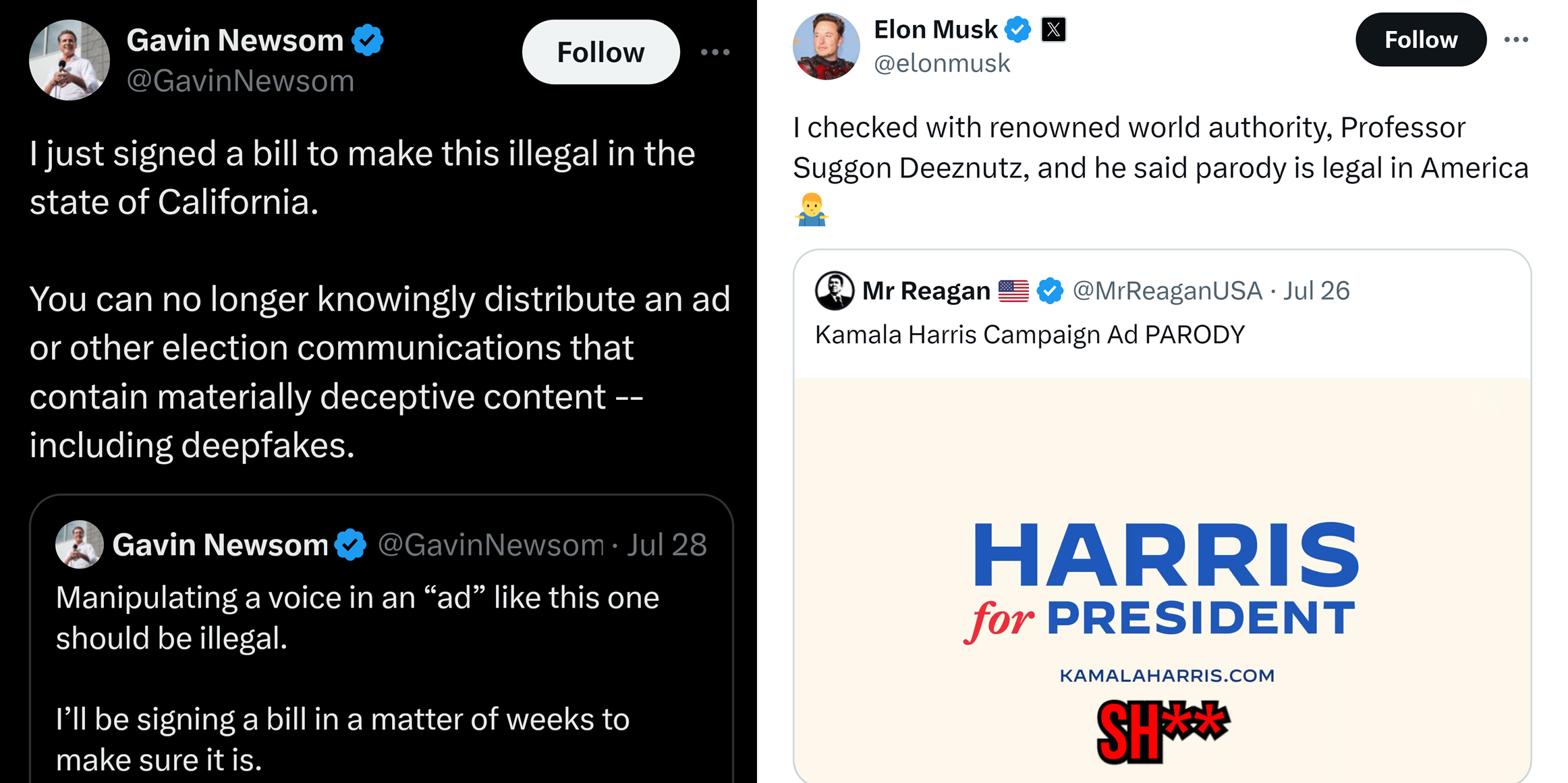
Montana is not alone. Plenty of states have attempted to restrict AI-generated political speech and discovered the constitutional difficulty of doing so. After the conservative YouTuber Christopher Kohls posted an AI-produced parody of then–Vice President Kamala Harris in the 2024 election, California passed Assembly Bill 2839, prohibiting the distribution of communications “that contains certain materially deceptive content” produced “with malice.” In 2025, a federal court ruled the law was unconstitutional and permanently enjoined California from enforcing the law.
Read more at Reason.